Project supported by the City of Antwerp
Diabetes On the Radar Antwerp
Ten Antwerp general practices map their full patient population for (risk of) type 2 diabetes. Nine months, free of charge, based on the data already in the patient record.
Applications open until Friday 4 September 2026

Realised with the support of the City of Antwerp
10
Antwerp practices
9 months
free of charge
45,000
patients on the radar
Why this project
A third of diabetes patients are undiagnosed
Type 2 diabetes is a silent epidemic. An estimated 650,000 people in Belgium have the condition, and a third of them do not know it. Complications such as kidney disease, heart failure and foot problems are largely avoidable with timely detection and structured follow-up. Yet systematic screening rarely happens in practice today.
The information needed to address this is already in the patient record, scattered across specialist letters, lab results and free-text notes. Co-Medic reads that data, structures it and turns it into a workable population overview. No extra coding, no change to the way you work.
Through Diabetes On the Radar Antwerp (DORA), ten Antwerp general practices receive nine months of free access to this overview for type 2 diabetes, complemented by a FINDRISC workflow for primary prevention. The City of Antwerp funds the project. The health gains land where they are greatest: practices are selected in neighbourhoods with a higher diabetes prevalence.
What your practice receives
Your full population in view, without extra work
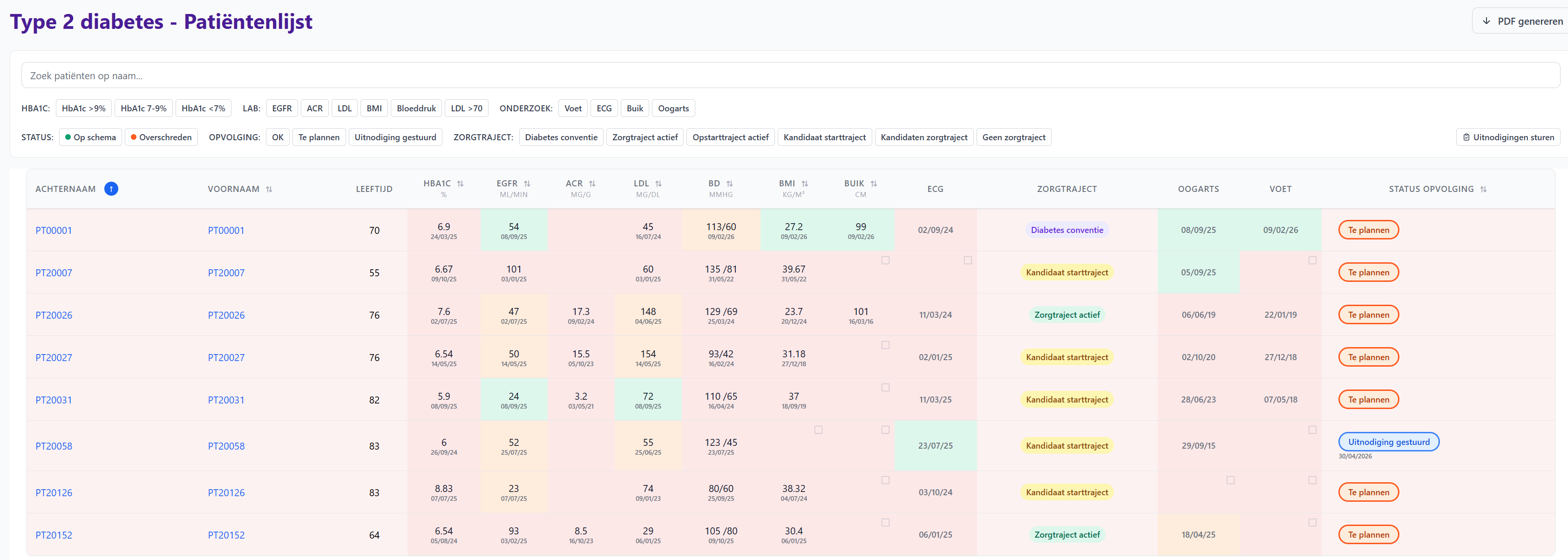
T2DM population overview
All patients with (risk of) type 2 diabetes in a single overview, even when the information only exists in free text or specialist letters. Every parameter links back to the source document.
Insight into missing screenings
Per patient you see which follow-up is missing: blood tests, urine analysis, eye and foot examinations. The practice nurse plans purposefully instead of searching.
FINDRISC workflow
The platform identifies candidates for a FINDRISC risk score. A structured workflow guides every step: scoring, targeted invitations, blood test and, where appropriate, guidance towards a suitable care pathway.
Baseline and follow-up measurement
At the start you receive an objective measurement of your practice: screening rate, follow-up status and care pathway candidates. After six months a second measurement shows the impact on your own population.
What it asks of your practice
Deliberately kept light
- One standardised export from your EHR, guided step by step (September)
- One hour of onboarding, at your practice (October)
- Active use of the overviews during the project, embedded in your existing routines
- A short interim survey (15 minutes), a final interview (30 minutes) and a peer-learning session with the other participating practices (1 hour)
No installation, no change of EHR, no extra coding work for the physicians.
Timeline
From webinar to closing event
-
30 July 2026
Webinar
From 12:30 to 13:30: introduction to the project, a demo of the platform and room for all your questions. Registered participants receive the recording afterwards.
-
4 September 2026
Application deadline
Practices can apply until Friday 4 September through the application form.
-
11 September 2026
Announcement of participating practices
All applicants are informed personally. Data extractions are scheduled with the selected practices right away.
-
September 2026
Data extraction and baseline measurement
Per practice we process the EHR export and establish the baseline: screening rate, follow-up status and care pathway candidates.
-
October 2026
Onboarding at the practice
We visit for an onboarding of about one hour. After that, your team works with the overviews for nine months.
-
December 2026
Interim evaluation
Short survey per practice (15 minutes): what works, where the barriers are. Feedback flows directly into product and workflow.
-
January to March 2027
Peer-learning session
The participating practices exchange experiences and approaches in a joint one-hour session.
-
April to June 2027
Follow-up measurement and final interview
A new measurement on the same indicators as the baseline, making the impact per practice visible. Concluded with a 30-minute final interview.
-
June 2027
Closing event and final report
Public closing event in Antwerp with the participating practices and the City of Antwerp, presenting the results of the project.
Selection
Ten places, purposefully allocated
There are ten places. If more than ten practices apply, selection is based on diabetes prevalence in the practice's neighbourhood (IMA-AIM Atlas) and geographic spread across the city, so the project lands in the neighbourhoods where the health gains are greatest.
Practices that signed a letter of intent during the project application receive priority, as long as prevalence and spread allow.
Webinar
Thursday 30 July 2026, 12:30 to 13:30
In a one-hour webinar we explain the project, demonstrate the platform and answer all your questions about participation, data processing and the practical start.
- What DORA means for your practice in concrete terms
- Demo of the T2DM population overview and the FINDRISC workflow
- The practical side: export, onboarding and timeline
- Open Q&A
Cannot attend? Everyone who registers automatically receives the recording afterwards.
Frequently asked questions
Everything you want to know
Realised with the support of the City of Antwerp
DORA is funded by the City of Antwerp as part of its support for innovation in the health economy. The project aligns with Antwerp's policy priorities on prevention and equal access to care: the selection of practices deliberately places the health gains in the neighbourhoods where the difference is greatest.
Questions about participating?
Ask them during the webinar, or contact us directly. We are happy to think along about what DORA could mean for your practice.
Applications open until Friday 4 September 2026